- Call Us: +91-9988543543

20th September 2025 | By Admin
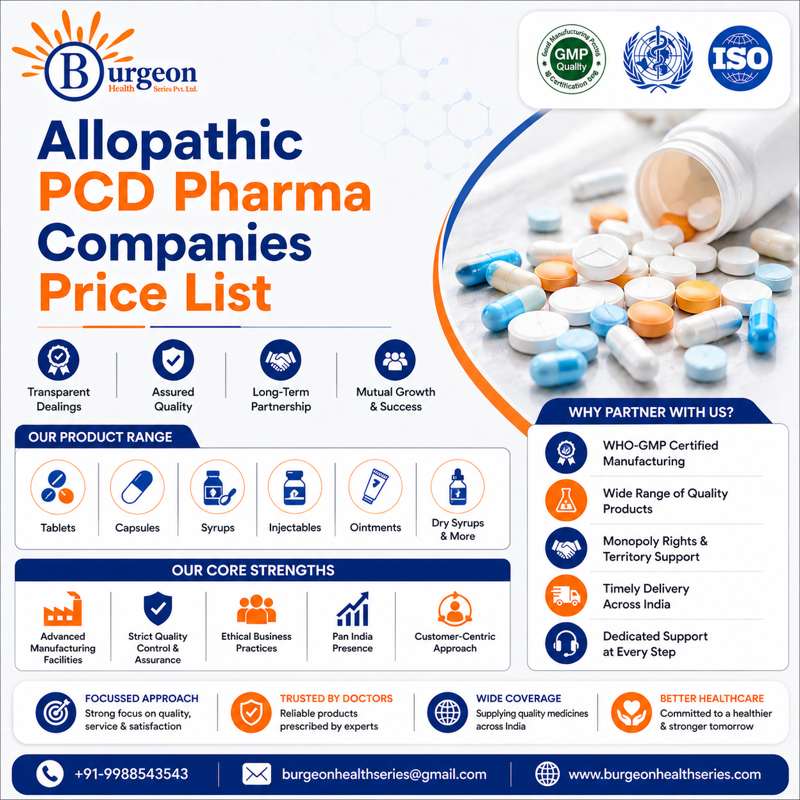
If you’re thinking of entering the pharmaceutical business via a PCD (Propaganda Cum Distribution) franchise, especially in allopathic medicines — having a complete and reliable price list from the company you partner with is crucial. This post breaks down what a good allopathic PCD pharma company’s price list should include, why it matters, and how it helps you build a profitable business.
An “Allopathic PCD Pharma Price List” is a detailed list provided by a pharma company that includes:
Names of medicines (tablets, syrups, capsules, injectables, etc.)
Pack size and formulation details (e.g. “10 × 10 tablets blister pack”, syrup bottles, injectable vials)
Distributor/franchise purchase price (rate at which you buy from company)
MRP (maximum retail price) or recommended retail price (if provided)
Minimum Order Quantity (MOQ) or minimum order value required for first purchase
Details of promotional or marketing support (if included)
This document is the foundation of your business planning — without it, you cannot accurately estimate initial investment, margins, or expected profit.
A good price list allows you to estimate how much your first stock will cost before committing. You’ll know upfront whether your budget suffices for minimum order requirements.
By comparing the distributor price vs MRP (or expected retail price), you can roughly calculate your margin per product — and thus estimate profitability based on stock volume.
Seeing full product range — from general medicines to syrups, capsules, injectables — helps you choose medicines relevant to your local demand. This reduces risk of unsold stock.
A company that shares a clear, up-to-date price list reflects transparency. It builds trust — and ensures you are working with a legitimate, ethical partner.
Without a price list, you may encounter unexpected costs — minimum order value, mandatory promotional material fees, hidden delivery or logistic charges. A price list helps avoid surprises.
While price lists vary between companies, you’ll often find:
Low-cost general medicines: basic analgesics, antibiotics, syrups, etc. — good for high-volume sales and lower investment risk .
Medium-range products: combinations, speciality tablets, injections — higher per-unit cost, but higher margins .
Entire stock-pack or franchise-setup offers: some companies list cost for initial franchise/stock packages (e.g. ₹20,000–₹30,000 or more depending on product range)
Promotional support details with price list: sometimes companies include MR bags, marketing literature, doctor-promotion aids as part of franchise package .
Shortlist needed medicines — choose products with good demand (general medicines, daily-use drugs, common syrups/injections).
Calculate initial stock cost — sum up distributor prices × MOQ or initial quantity to see if it fits your budget.
Project margin & turnover — using MRP / expected selling price, estimate gross margin and possible turnover.
Add extras: logistics, storage, marketing — include transportation, storage conditions, marketing costs to get real profit estimate.
Plan re-orders & cash flow — based on demand and sales speed, use price list to forecast re-ordering cycles.
That the price list is recent and complete — covering all formulations (tablets, syrups, injections, etc.).
That product quality is certified (GMP / WHO / ISO) — because cheap price with poor quality harms reputation.
Whether there is monopoly/exclusive territory right for your area — so you don’t compete with same brand.
Transparency about packaging, minimum orders, delivery timelines, promotional/marketing support.
Return/reorder policy and consistent supply chain — because stockouts or delays hurt your credibility.
This price list approach is suitable for:
New entrepreneurs starting pharma distribution with limited capital.
Medical representatives or retailers expanding their product range.
Anyone looking for low-risk, manageable business — without manufacturing hassles.
Distributors wanting to compare multiple companies and choose the best franchise after evaluating costs, margins, and product range.
Before you partner with any allopathic PCD pharma company — always ask for a complete price list. It’s the most important document for budgeting, product selection, margin calculation, and risk management.
A transparent and updated price list helps you build a profitable, sustainable PCD pharma business in 2025 and beyond.